Legal & Process
Renting a Room in Dubai: What the New 2026 Shared Housing Law Means
By Dhananjay Arora · CEO & Founder, Al Ranim Properties
Published 15 September 2026 · Updated 14 September 2026 · 8 min read

Dubai's Law No. 4 of 2026 has changed how shared housing works. Here is what the new permits, subletting rules, fines and compliance deadlines mean if you rent a room, own a property or invest in one.
Renting a room in Dubai has always been part of how the city houses itself. Professionals have shared an apartment and residents have rented a room within a property. Shared accommodation has typically offered a more economical option compared to renting an entire property.
However, in 2026 things have shifted.
Dubai has introduced Law No. 4 of 2026 regulating the management and occupancy of shared housing. This law has established a framework for shared accommodation in Dubai with guidelines for the provision, management and occupancy of shared accommodation throughout the emirate.
What is important to note is that shared accommodation is not banned in Dubai. Rather, the focus is shifting away from informal room rentals, overcrowding, and unauthorised subletting, towards a system of regulated shared accommodation with registered arrangements, permits and safety requirements.
Here is what the new law means for landlords, tenants and property investors.
What Is Considered Shared Accommodation in Dubai?
Shared housing typically refers to a situation where two or more tenants inhabit various areas of the same building and share use of facilities such as bathrooms, kitchens or other areas.

The new law will cover the entire emirate, including properties located within free zones and private development zones.
Collective labour accommodation is not covered by this law and is dealt with separately.
The aims are greater than just regulation of the rental of rooms. According to the Government of Dubai the purpose of the law is to enhance health and safety, minimise overcrowding, tackle improper use of properties, increase transparency in this element of the rental market, and safeguard both landlords and tenants.
Do You Need a Permit for Shared Accommodation in Dubai?
Yes.
Appropriate permission is required before a property can be designated for shared accommodation under the new regulation.
Dubai Municipality will be responsible for managing the shared housing system and establishing the standards for shared housing including locations where shared housing may be allowed, maximum number of occupants per property, minimum space per occupant, shared areas needed and building, health and safety standards.
The Municipality will also be responsible for the management of the integrated system used for the permitting and record keeping process.
For property owners, it should be noted that the law does not allow for a single set number of occupants allowed in all villas and apartments. The number of occupants allowed may vary per property and based on the standards set by the Municipality. Therefore, property owners should be wary of general information available online regarding a specific number of occupants allowed per bedroom.
How Long Is a Shared Housing Permit Valid?
A standard permit has a one year term and can be renewed.
A permit up to two years in duration may also be requested and will be processed according to the approval process.
For a permit renewal, an application is typically required at least 30 days prior to the expiration date of the existing permit.
Dubai Municipality may also provide one-time extensions to operators who were previously operating shared housing prior to the implementation of the law. These extensions will give operators additional time to comply with the new regulations.
Can a Tenant Rent Out a Room to Someone Else?
This is a very significant change.
Only the owner or an authorised establishment can rent shared space under the new shared housing scheme. Individuals who occupy or rent a room, bed space or other part of a property can no longer sublet this to another person.
The permitted arrangements are: owner to occupier; authorised establishment managing and renting the property on behalf of the owner; or owner renting property to an authorised establishment to provide approved shared space.
Previously, informal arrangements have been quite widespread. For instance, it has been possible to rent a two bedroom property and then obtain private rent from a number of individuals who occupy individual rooms within the property.
Under the new scheme, possession of an existing landlord tenancy agreement does not automatically entitle a tenant to provide shared housing.
What Does the Law Mean for Landlords?
Landlords who are currently using their property as informal shared housing need to be cautious about the new regulations.
A landlord must know who actually occupies their property. The named tenant in the primary tenancy agreement is not necessarily the only occupant.
Landlords should find out if any specific rooms or areas are being sublet. Unauthorised subletting could cause contractual and regulatory issues.
Landlords should ascertain if a shared housing permit is needed for the property. If the property is being used for shared housing, the applicable permit process should be considered.
Landlords should also ascertain if the property meets occupancy and safety requirements. Dubai Municipality has established requirements for occupancy density, space per occupant and required facilities in a unit.
Because of this, property management and tenant selection for landlords has become even more important with the new regulations especially if the property is being used in a different capacity than originally agreed.What Does It Mean If You Already Live in Shared Accommodation?
Existing shared accommodation was not made illegal at the implementation of the law.
Existing operators and owners of shared accommodation are given one year to get their shared accommodation and operation into compliance with the new law. The Dubai Municipality may also offer one-off extensions if applicable.

For the tenant, this legislation has made one question much more significant. Who is actually renting you the room and do they have the authority to rent the room? Previously this was a trivial matter. Now it can mean the difference between a recognised tenancy and one that is not.
A person who is offering a room may be the owner of the property, they may be an establishment authorised to operate shared accommodation, or they may be a tenant themselves with no authority to rent to anyone. Under the new legislation only the first two options are allowed.
There are some things that a tenant can do before entering into a shared housing situation:
Find out if the person who is offering the unit is the owner or an authorised operator
Find out the type of tenancy or occupancy agreement that is being offered
Make sure the housing is being operated in compliance with the applicable rules for shared housing
Find out exactly what is included in the rental payment
Find out how the deposit will be received and all other payments will be recorded
Find out if the occupancy provisions in the property comply with the applicable requirements
Although cash and apps may make communication convenient at present, should a dispute arise the tenant would have very limited proof. If a written agreement exists and all payment is recorded then the paying tenant is protected.
What Are the Fines for Breaking Dubai's Shared Housing Rules?
Penalties may be heavy.
For violation of Law No. 4 of 2026 and its implementing regulations, a fine between AED 500 and AED 500,000 may be imposed. For a repeat violation within one year, the fine may be doubled up to a maximum of AED 1 million.
In addition to fines, the following enforcement actions may also be imposed, depending on the situation: suspension of the activity for up to six months; cancellation of a permit; revocation of a business licence; termination of public services until a violation is remedied; or eviction from property that does not meet required conditions.
Any disputes relating to the rights and obligations in a shared accommodation shall be referred exclusively to the Dubai Rental Disputes Center.
Why Has Dubai Introduced These Rules?
Shared housing is not the issue per se.
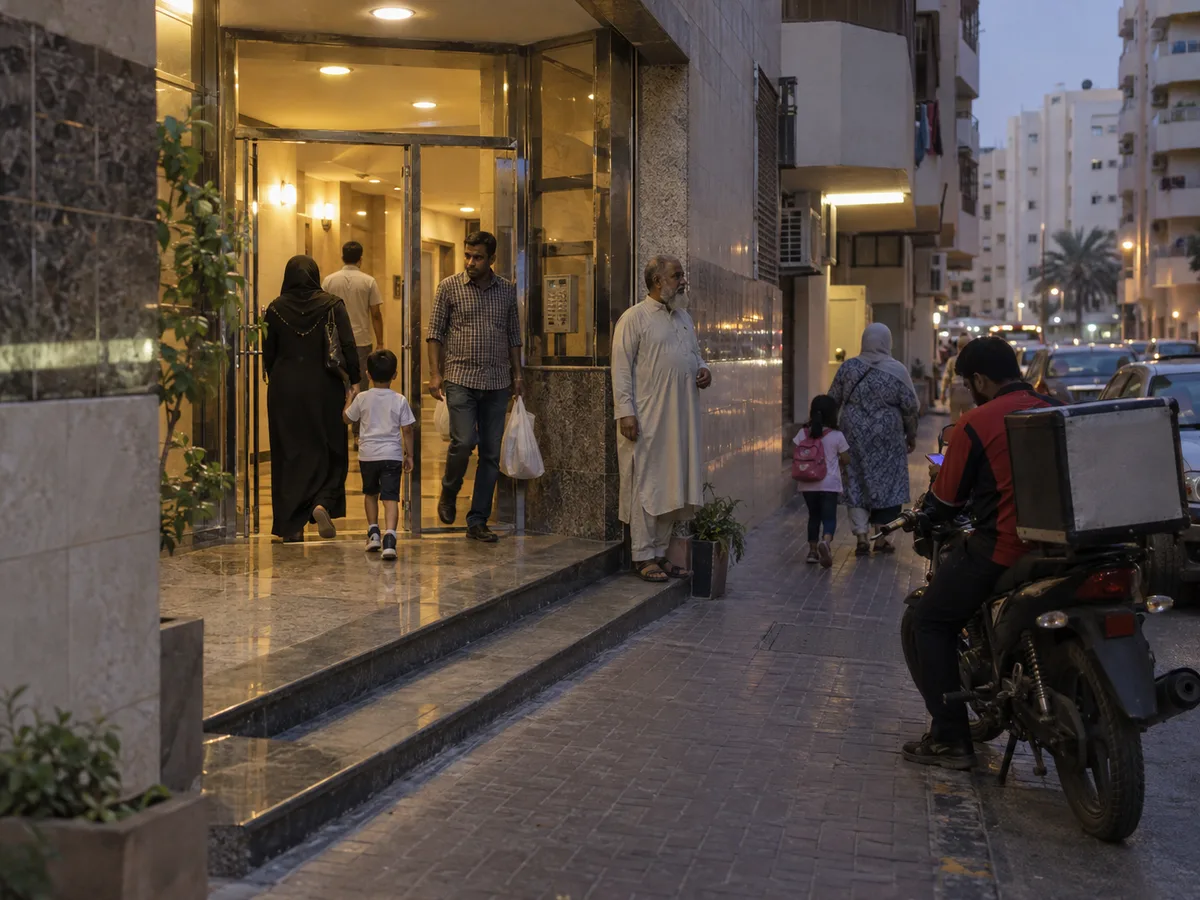
The issue lies in the potential that arises when a building intended to accommodate a specific number of people is divided into a large number of bedrooms, partitions or rooms without sufficient management. This can result in issues regarding overcrowding, sanitation, building services, parking, the broader residential environment and fire safety.
Consequently, the Dubai Municipality is now responsible for issues such as minimum floor space, maximum occupancy, facilities and the locations in which shared housing can be provided.
The Dubai Land Department also plays a key role. It is responsible for the electronic shared housing registry, defining the information that should be contained in shared housing contracts and creating a rent indicator specific to shared housing.
In reality this signifies that shared housing is moving towards being recognised and regulated within the Dubai rental market rather than continuing to rely mainly on informal arrangements.What Should Property Investors Take From This?
For investors however, the message is more than just the introduction of new restrictions.
There is a greater shift towards evaluating the investment in converting a typical residential property into a number of separately let rooms in a very different way.
While a high headline rent may be appealing, the analysis should include whether such a use is permitted, whether the conversion meets safety and occupancy standards, how the property will be managed and what compliance requirements exist.
Therefore investors looking at comparing a traditional annual tenancy to shared accommodation should look beyond the gross rent and consider whether the highest promoted rent represents the most viable return.
The honest comparison is against what the same unit earns on a normal annual lease. In older central areas it is worth checking what apartments for rent in Bur Dubai are actually achieving before assuming a room by room model beats it.
FAQ
Frequently asked questions
Shared accommodation is still allowed but properties used for shared accommodation are now covered by a formal system of regulation. This includes permits, occupancy and other conditions.
Renting a room in Dubai is still permitted if the accommodation is provided in accordance with the law and meets the conditions for shared housing.
Under the new system of shared housing, tenants and other occupants are not permitted to sublet any portion of a shared housing unit. Only the owner or an authorised entity may rent shared accommodation.
Shared accommodation may still be provided as long as the property and the shared accommodation meets all conditions associated with the permit, occupancy, safety and registration for shared housing.
Up to AED 500,000 can be imposed for individual violations. For a repeat violation within one year a penalty of up to double the original amount, a maximum of AED 1 million, may be imposed.
Dubai's 2026 shared housing rules do not prohibit renting an apartment or room. Instead, they do impose new requirements on how such rentals can occur.
For renters, this means more care in ensuring they are actually renting from the correct party and that the terms of the rental are clearly defined. Anyone renting a room in Dubai should now treat the question of who holds the right to let that room as the first thing to check, not the last.
For landlords, it means looking beyond the primary tenant and understanding what is actually taking place within the rented space.
For investors looking to capitalise on higher rental returns through shared housing, compliance with the rules must be factored into the investment decision from the outset.
If a room share no longer looks like the right answer, it is worth seeing what a whole unit costs before deciding. Our apartments and villas for rent across Dubai are live listings with current asking rents, and Al Ranim Properties can talk you through how the areas compare on price, commute and what you actually get for the money.
Work with Al Ranim Properties
Found this useful? Talk to a consultant about your own situation.