Legal & Process
Oqood in Dubai (2026): Meaning, Certificate, Fees and Title Deed
By Dhananjay Arora · CEO & Founder, Al Ranim Properties
Published 23 October 2026 · 10 min read
When purchasing property off plan you will not be issued a title deed at the time of agreement but instead will be issued an Oqood. This page will explain what an Oqood is, how to check an Oqood, the cost of an Oqood and what happens to your Oqood upon completion of the building.
Key takeaways
- Oqood is the registration of off plan purchases with the Dubai Land Department.
- The developer is required to register the purchase within 90 days of the agreement and the buyer will be sent a provisional registration certificate by email.
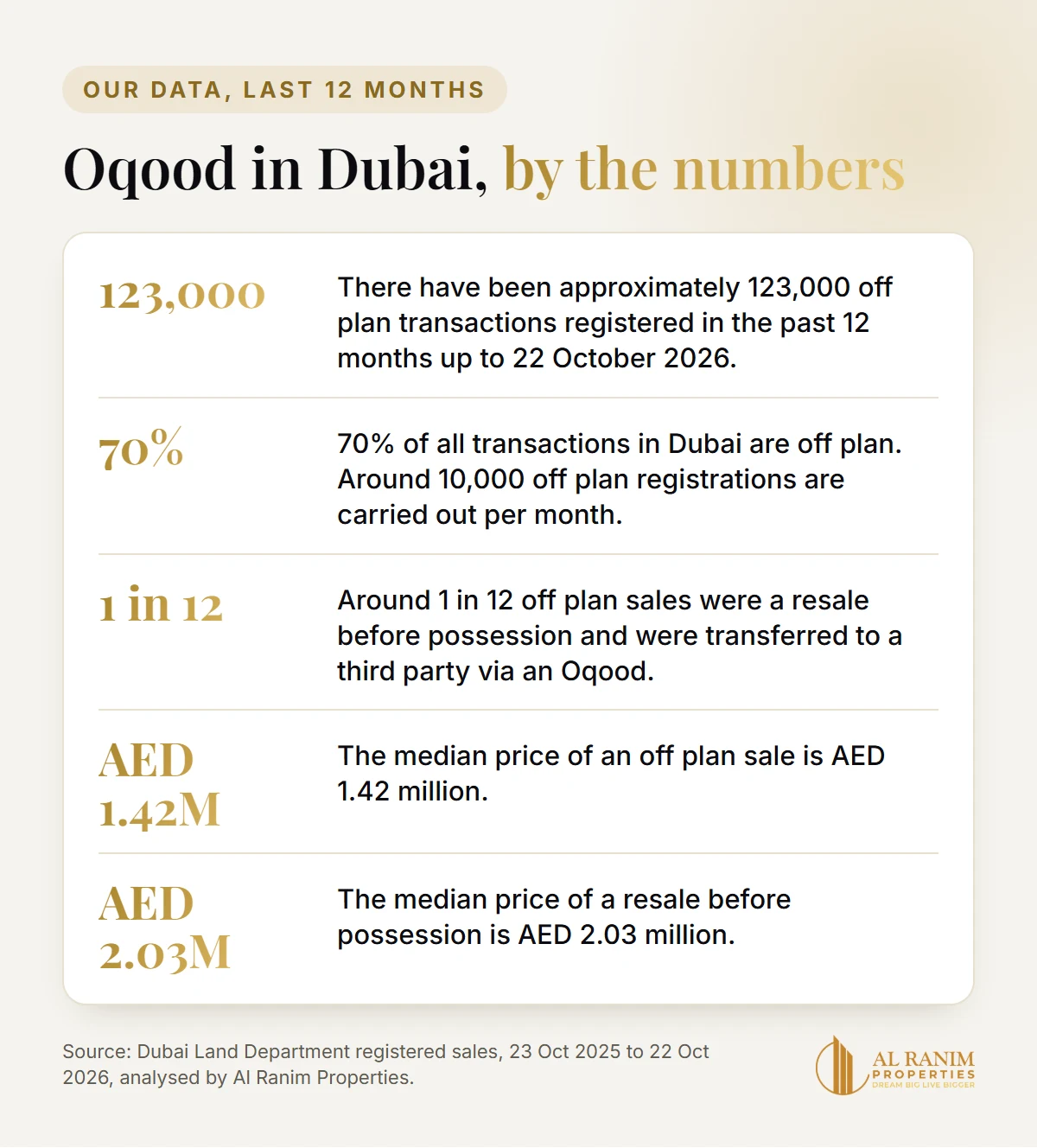
- 70% of property transactions in Dubai over the past year (up to 22 October 2026) have been off plan. As a result most property purchases now begin with an Oqood rather than a title deed.
- Upon completion of the building and payment in full of the purchase price your title deed will be issued as a replacement to your Oqood. There is no additional charge of the 4% fee.
The short answer
Oqood is the registration of an off plan transaction with the Dubai Land Department. When a developer sells property to a buyer an agreement is made. Within 90 days of this agreement the developer must register the transaction. The buyer is then issued a provisional registration certificate. An Oqood secures the buyer’s interest in the property until a title deed can be issued for the completed building.
What Is Oqood in Dubai?
The term Oqood comes from the Arabic word for contract. In Dubai Oqood is the system used by the Dubai Land Department for registration of all off plan property transactions. This system has been in place since Law No. 13 of 2008. Property transactions that are not registered in Oqood may be null and void. Oqood provides some interim protection to the buyer until the building is completed.
What an Oqood is
- An interim registration held by the Dubai Land Department for an off plan transaction.
- Demonstrates that the unit is owned and stops the seller from selling the unit to a third party.
- Allows resale and mortgage of the unit before physical possession according to the conditions set by the developer.
- Provided by the developer through the developer module on the Land Department system.
What it is not
- Does not constitute a title. A title is provided on possession and payment.
- Is not a sales receipt from the developer’s sales office or a booking for the unit.
- Is not registered by the buyer but is registered by the developer.
Oqood in Numbers: What the Land Department's Records Show
To gain an idea of the number of transactions that start with an Oqood, all real estate transactions registered with the Dubai Land Department over the past year (up to 22 October 2026) were analysed. Off plan sales now make up the majority of sales in Dubai. Many off plan sales are also before possession and are a resale.
How Oqood Registration Works: From Signing to Title Deed
Oqood is part of an off plan purchase. The majority of the paperwork for the purchase is managed by the developer but you should be aware of this process to ensure everything is progressing as it should.
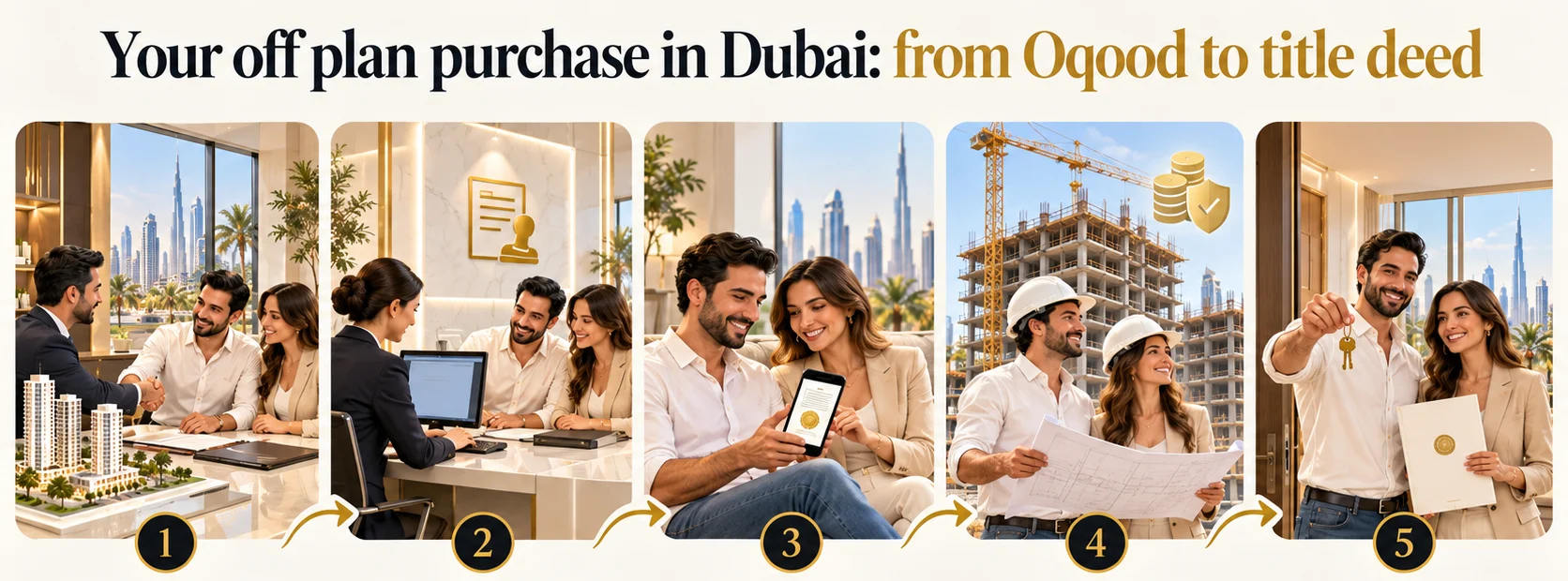
- Sign with the developer. When purchasing from the developer you will choose the unit you want to buy and pay a booking fee. You will also sign the purchase and sale agreement for that unit.
- Registered on Oqood. Within 90 days of the purchase agreement date the developer will enter that sale into the Oqood system used by the Land Department.
- Your Oqood certificate. Once this has occurred you will be sent a provisional registration certificate by email confirming that you now own that unit.
- Pay as it is built. As the units are being built you will pay the instalments from your payment plan and these payments are held in the escrow account for that development.
- Handover. When the units are completed and the purchase price has been fully paid the developer will register your purchase and issue you with a title deed to that unit.

The Oqood Certificate (Pre Title Deed)
This is known as a provisional registration e-certificate or pre title deed and will be sent to you by email once your purchase has been registered by the developer. Keep this in conjunction with your purchase and sale agreement as it will be required should you wish to sell the unit, get a mortgage or receive your title deed.
What to check on your certificate
The details on the certificate must match those on the contract. Your name and passport must match those details on the purchase agreement. The building, unit and project number must match those purchased and the price must match the price details on the contract. The certificate must have been obtained within 90 days of the date of agreement.
No certificate after 90 days? If no certificate has been received within 90 days contact the developer to register the property. If this does not work then contact the Land Department, Real Estate Registration Assurance or call the Land Department on 800 4488.
Oqood Fees: What You Pay
The registration charge for off plan purchases is 4% of the purchase price. Half of this payment is made by the seller and half by the buyer. For a new development the developer is the seller but in most contracts the full registration charge of 4% is passed to the buyer. If a proposal states that registration fees are waived this means the developer will pay the registration fee.
| Fee (AED) | Buying from the developer, AED 1.4 million | Off plan resale, AED 2 million |
|---|---|---|
| Land Department registration fee (4%, paid by the buyer in practice) | 56,000 | 80,000 |
| Oqood fixed charges (AED 1,000 portal fee + AED 20) | 1,020 | Not charged |
| Trustee office fee for the transfer (AED 4,000 + VAT) | Not charged | 4,200 |
| Developer's no objection certificate | Not charged | Set by the developer |
| Agency fee (2% + VAT on a resale) | Paid by the developer | 42,000 |
| Conveyancing fee (AED 3,500 + VAT) | Not usually needed | 3,675 |
| Title deed and map at handover | 580 | 580 |
| Total (before any NOC fee) | AED 57,600 | AED 130,455 |
| Share of the price | 4.1% | 6.5% |
Our calculation, using the Dubai Land Department's initial sale and title deed service pages (read 23 Oct 2026) and current market practice. The Land Department lists the 4% as 2% for the seller and 2% for the buyer, and AED 250 each for the title deed and map; on transfer day the buyer normally pays the full 4% and AED 580. Prices are the median off plan sale and the median resale before handover over the last 12 months, rounded. If a bank finances the purchase, add 0.25% of the loan for mortgage registration and a conveyancing fee of AED 6,600 + VAT.
At handover: There is no additional 4% at handover. At the time of completion there are only the title and plan fees. The registration fee has been paid at the Oqood stage.
Agency fee: If buying from the developer no agency fee is required since the developer will pay the fee incurred by the agent. When selling an off plan purchase the buyer usually pays an agency fee of 2% of the transaction value plus VAT.
Oqood vs Title Deed: What Is the Difference?
Title and Oqood both represent property ownership but at different times.
| Oqood | Title deed | |
|---|---|---|
| Stage | While the building is under construction | After completion and full payment |
| Register | Interim register (Oqood) | Main Real Estate Register |
| Who files it | The developer, within 90 days of signing | The developer at handover, issued by the Land Department |
| What you receive | Provisional registration e-certificate | Title deed and map |
| Can you sell? | Yes, with the developer's no objection certificate | Yes |
| Can you mortgage it? | Yes, banks lend up to 50% of the value | Yes, normal mortgage limits apply |
| Main fee | 4% of the price plus AED 1,020 | Title deed and map fees only (AED 580 in practice) |
Sources: Law No. 13 of 2008 (Articles 3, 6 and 8), Dubai Land Department service pages and FAQ, UAE Central Bank mortgage rules for off plan property.
Selling Off Plan Before Handover: How the Oqood Moves
An off plan can be sold before hand over and the Oqood will pass to the new buyer provided the developer issues a no objection certificate. This is allowed by the Land Department. Certain developers may ask for an initial payment of a certain percentage (30-40%) of the selling price before resale is allowed. Make sure this is reflected in your contract before you look at resale.
- Check the resale rule. Contract should reflect the requirement for an initial payment and the conditions for resale.
- Get the developer's NOC. Request no objection certificate from developer and get confirmation of the fee for this.
- Sign with the buyer. Execute a sale agreement with the buyer and agree how the 4% transfer charges will be split.
- Transfer at a trustee office. Proceed at a Land Department trustee office and the Oqood will pass to the new buyer.
Developer fees: Under Law No. 13 of 2008 only charges approved by the Land Department are allowable as administrative charges for resale by a developer. If a substantial charge is requested for transfer or assignment ask for an explanation of the purpose of the charge.
What If Something Goes Wrong?
Resale of off plan properties is typically easy. It is good to be familiar with the rules in case a dispute arises. As of 2017 the rules do differ according to the degree of construction that has been completed.
A developer cannot terminate a contract by their own initiative should a buyer default in payment. The developer must give notice to the Land Department who will give the defaulting buyer a written 30 day notice to pay. The amount the developer can retain should the buyer fail to pay after this notice will be based upon the degree of development completed.
| Building progress | What the developer may do after the 30-day notice |
|---|---|
| More than 80% built | Keep the contract and claim the balance, ask the Land Department to auction the unit, or cancel and keep up to 40% of the unit's value |
| 60% to 80% built | Cancel and keep up to 40% of the unit's value |
| Less than 60% built, work started | Cancel and keep up to 25% of the unit's value |
| Work not started, not the developer's fault | Cancel and keep up to 30% of the amount paid, refunding the rest within 60 days |
Source: Law No. 19 of 2017, which replaced Article 11 of Law No. 13 of 2008. For the 40% and 25% cases, the refund is due within one year of cancelling, or within 60 days of reselling the unit, whichever comes first.
Sale never registered
An off plan transaction not recorded on the interim register may be rendered null and void. Request your certificate and ensure that 90 days do not elapsed.
Project cancelled
If a development is cancelled the developer must return all monies paid within 60 days of cancellation. The Land Department mandates this.
You stop paying
If a buyer defaults after partial construction has been completed the developer may retain up to 25% or 40% of the value of the unit based on the amount of construction completed. Notify the developer as soon as there is a risk of default by the buyer.
Stage not reached
No instalment is due for construction that has not yet been completed. The buyer may also request a statement of the extent of construction from the regulator.
Escrow and Off Plan Mortgages
Payments are not made directly to the developer. Since 2007 all monies for off plan units must be deposited in an escrow account with a bank. Escrow monies may only be used for the development in question. Escrow monies are released in stages upon verification of the extent of construction by an engineer visiting the development.
- A developer may use up to 5% of all sales from the escrow account for marketing.
- Once units are registered in the name of the buyer 5% of escrow monies remain in the bank for a period of one year.
- Misappropriation of monies in a development may result in imprisonment and a minimum fine of AED 100,000.
- A mortgage can be obtained on an off plan unit. However, a maximum loan from a bank is only 50% of the value of the unit.

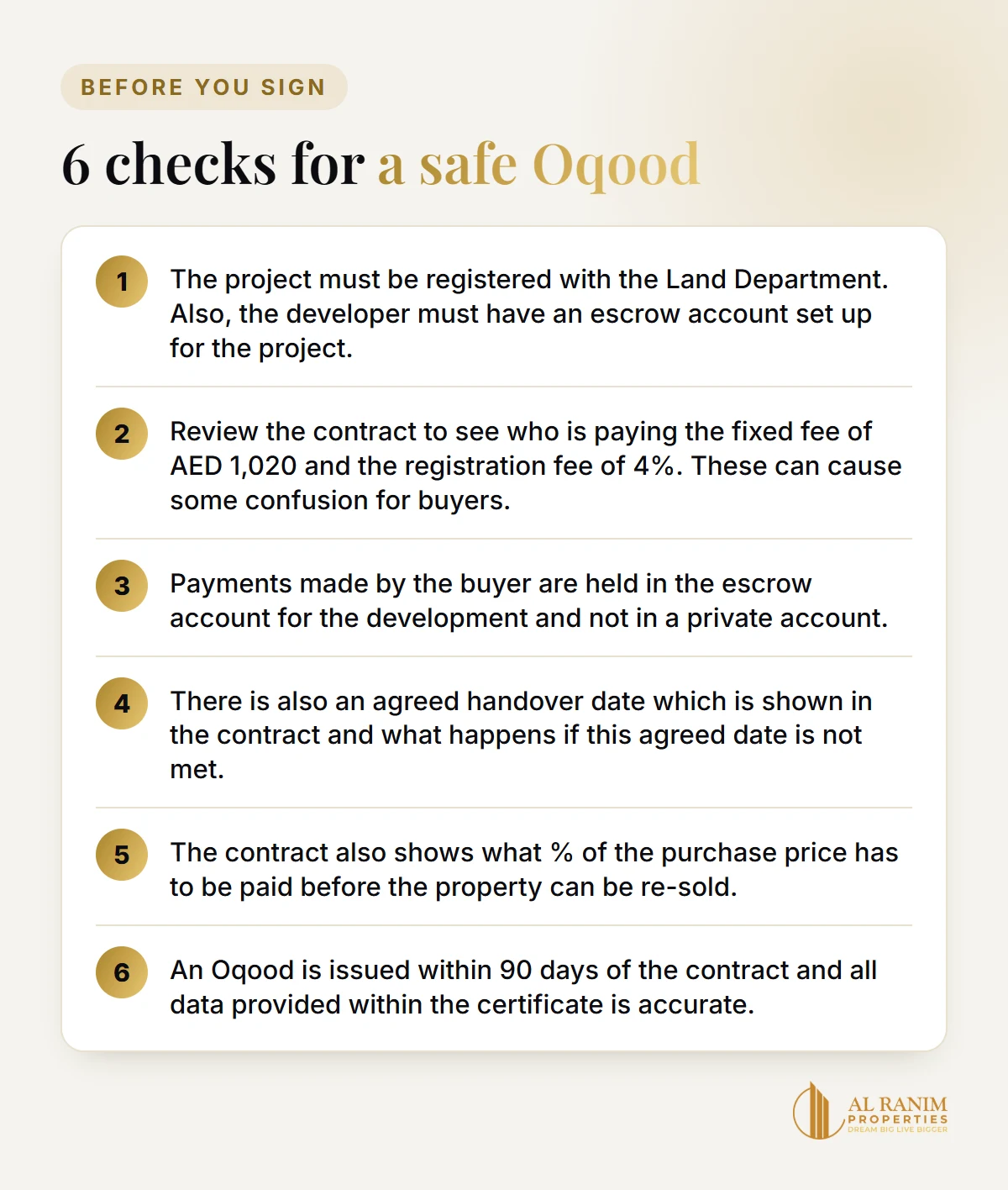
Oqood Checklist: 6 Things to Check Before You Sign
There are a few things you should look at before you enter into buying an off plan house. They will not take long but may save you from many problems down the track.
The bottom line
- An off plan home is a house that is under construction. An Oqood certifies the ownership of the off plan property.
- The developer is required to register the sale within 90 days of contract and care should be taken when dealing with the certificate.
- You are protected for your payments in escrow and upon payment in full and completion of the building the title is issued.
Want to buy an off plan home? We can assist with finding property launches, checking the developer, payment plan etc and can also provide help from the issuing of the Oqood to the release of the title.
Al Ranim Forum
Have a question about Dubai property?
Ask the community and our licensed team about buying, renting or selling in Dubai. No account needed.
FAQ
Frequently asked questions
Oqood registration is for off plan purchases registered with the Dubai Land Department. When purchasing an off plan building the developer must register the sale to Oqood within 90 days of the contract and the buyer will receive a temporary registration.
No. Oqood registration is for off plan purchases (i.e. while the building is under construction). Once payment is in full and the building is completed the buyer will receive the title deed.
The developer must register the sale within 90 days of the contract between the seller and buyer.
Registration fee for Oqood is 4% as charged by the Land Department. This is normally completely passed to the purchasing party in the contract. There is also a fixed fee of AED 1,020. The 4% registration fee does not reappear at transfer but fees for the title and plan documents do apply.
Through the developer. The sale is registered through the developer on the Dubai Land Department website. The registration will then be sent to the buyer via email.
Resale is allowed provided the developer gives permission in the form of a no objection certificate. Some developers might ask for a partial payment of sale value as a condition before resale is allowed. Such a condition should be mentioned in the sale contract. Before suggesting resale please verify the condition.
Once the building is completed and all payments are in full the developer will register the unit and the title deed will be issued to the buyer. At this point the Oqood registration is no longer needed.
Work with Al Ranim Properties
Found this useful? Talk to a consultant about your own situation.