Buying
Snagging in Dubai: What It Means, What It Costs and How to Take Handover of a New Home
By Dhananjay Arora · CEO & Founder, Al Ranim Properties
Published 8 November 2026 · 12 min read
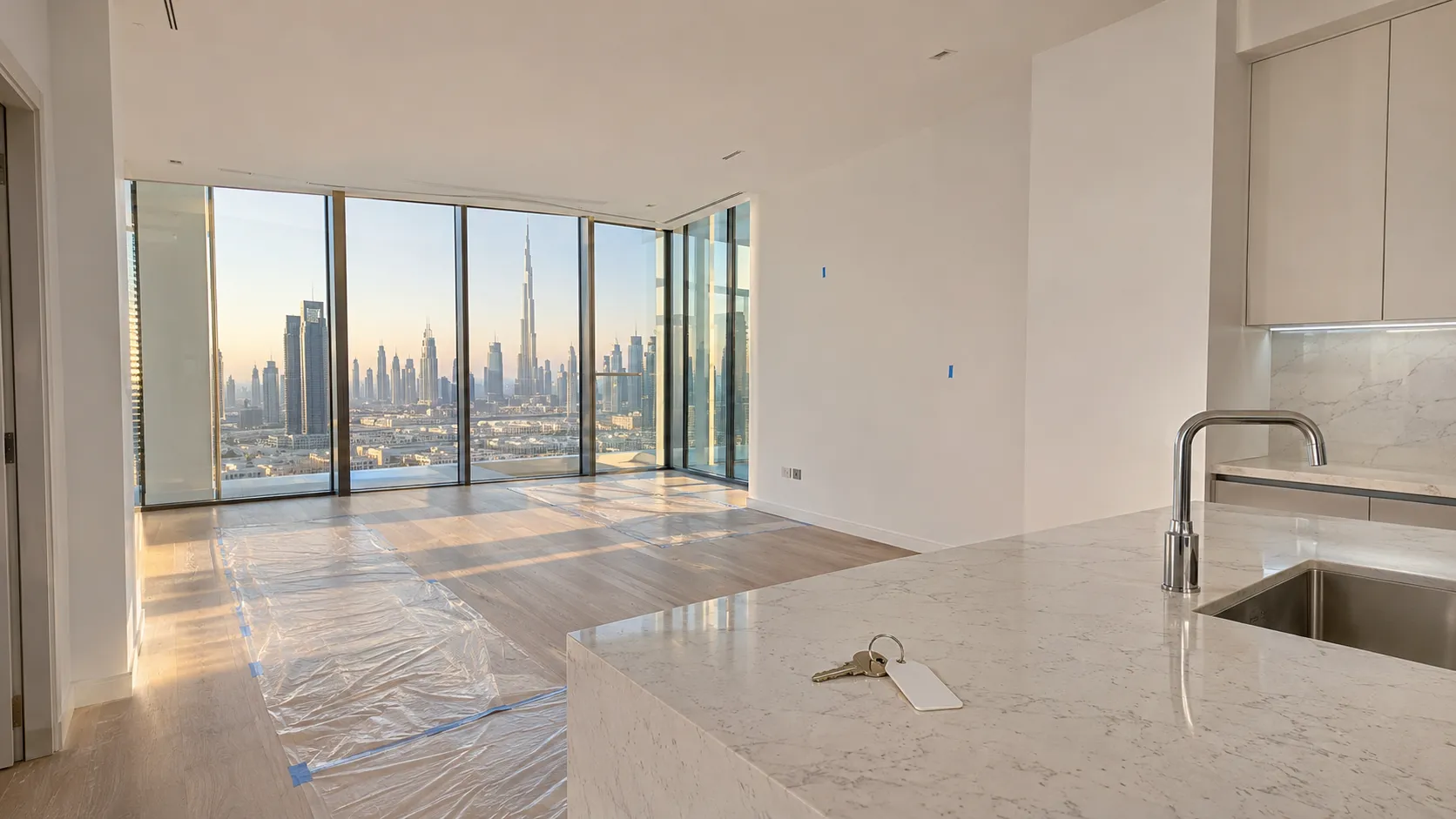
Property snagging is a process that occurs prior to the handover of a new property in Dubai. Al Ranim Properties has researched 202,193 off plan units sold by developers in Dubai between 2022 and 2024 many of which are now at handover. In this guide we outline snagging charges based on the size of the property, charges at the time of handover and what the developer is required to fix after handover.
Key takeaways
- Snagging is a process where a new build property is examined and any omissions or faults are reported to the developer so that the developer can do the necessary work before handover.
- 202,193 off plan properties have been sold by Dubai developers between 2022 and 2024. This number has been derived from the data submitted to Dubai Land Department. Many of these properties are now in handover.
- Snagging charges in Dubai differ from company to company. Publicly advertised snagging fees range from approximately AED 500 for a studio to approximately AED 2,500 for a townhouse and approximately AED 3,500 for a villa.
- We found no law that compels snagging. Law No. 6 of 2019 provides that a developer is responsible for correcting defective installations for a period of one year from handover and structural faults for a period of ten years from the issuance of the completion certificate.
- Delaying handover over minor issues can cost you. From the completion of the property service charges can start and the one year repair period can also start without you.
- At handover you will have to pay the last balance, a DEWA deposit of AED 2,000 for apartments and AED 4,000 for villas and a title deed charge if mentioned in the sales contract.
The short answer
- When you receive the letter from the developer to hand over your property, please note the amount payable and within what time period the payment must be made.
- Either pay the amount owed or arrange for the mortgage lender to transfer the monies due based on the instructions in your handover letter.
- Once you have been permitted access to your property by the developer please arrange a snagging visit. Following the snagging visit please provide the developer with a list of issues found, including photos. The list should be numbered.
- Follow up with a second visit and ensure the important issues found on your initial visit have been fixed. Only at this point should you sign the handover documents.
- Once the major items have been rectified please collect your keys. Any issues found after handover can be reported in writing within 1 year of handover.
What Is Snagging? Snagging Meaning in Plain English
Snagging is the process of inspecting a newly constructed property prior to handover. All issues are listed on a snag list and the developer is required to rectify the items listed on the snag list at its own cost prior to handover.
A snag is a minor issue that occurs in a new development. This could be an unpainted space, a hollow tile, a non functioning power outlet or a door that fails to close properly. Snagging is performed prior to possession in order to identify any issues that have occurred during the construction of the development. Any issues that can be rectified are listed on a snag list provided to the developer.
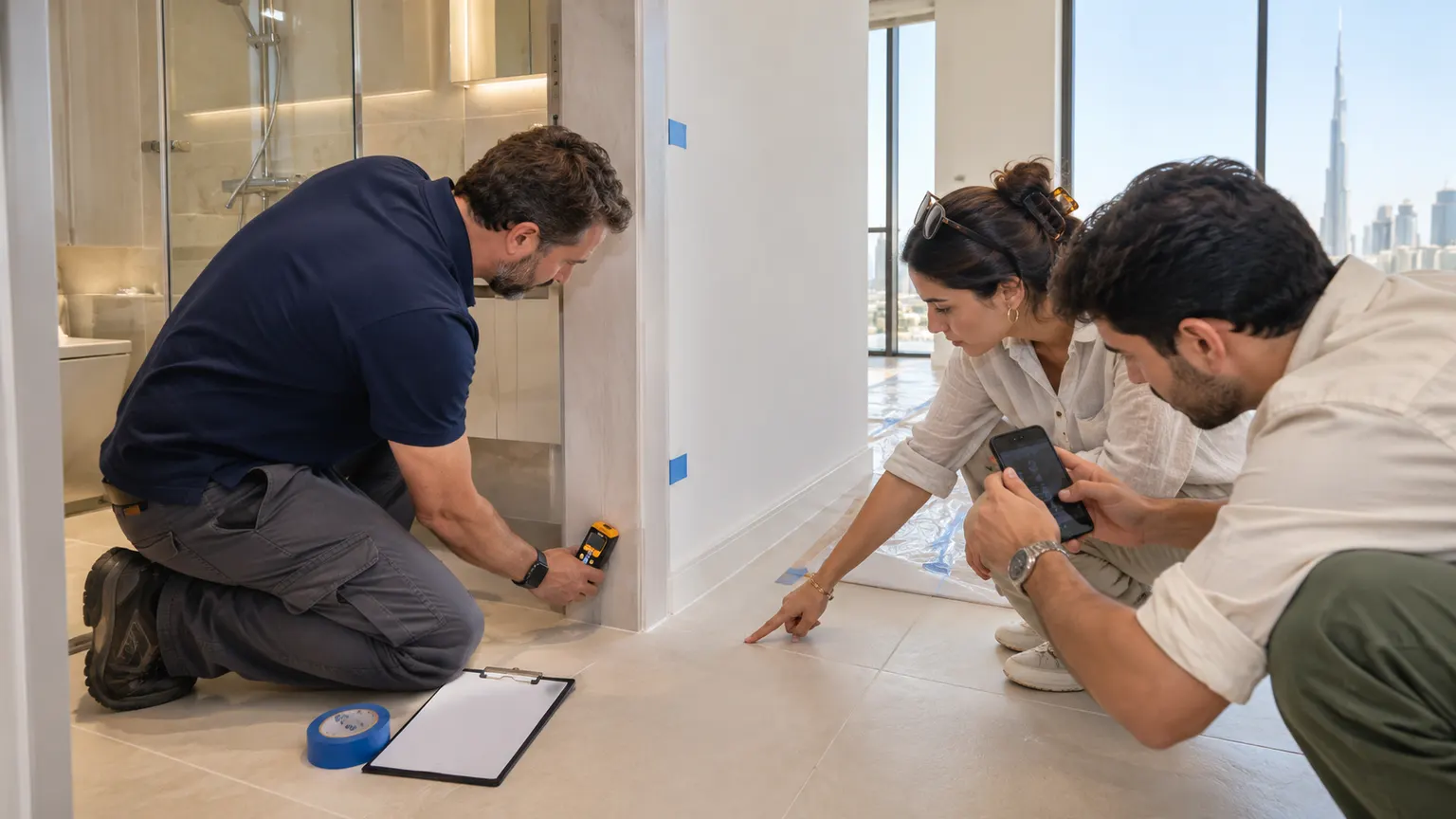
Snagging in Dubai generally occurs between the handing of a possession notice from the developer and the actual possession of the property. Snagging may also be carried out by a snagging service. These services are able to utilise moisture meters and thermal imaging equipment to aid in the identification of issues that may not be readily identifiable by the unaided eye. Alternatively snagging may also be carried out by the end buyer.
Snagging
Visual inspection of a new development prior to possession on a room by room basis in comparison to the contract plans and specifications.
De-snagging
Follow up inspection prior to possession in order to verify that all items detailed on a snag list have been rectified.
Property inspection
More detailed inspection of a new or existing development. This inspection is often carried out prior to the sale of a resale property or at the start and end of a lease.
Why Snagging Matters Now: 202,193 Homes Reaching Handover
More new properties are being completed in Dubai than has been the case in many years. Cavendish Maxwell has estimated approximately 40,400 new properties were completed in 2025 and approximately 24,800 new properties were completed in the first half of 2026. Cushman & Wakefield has estimated approximately 55,600 new properties will be completed in 2026. This would be the highest number of new properties completed in a year since 2008. These two estimates are not identical as each firm defines completion slightly differently.
Sales data from the Dubai Land Department from January 2022 through December 2024 has been used in this research. A total of 399,168 sales were reviewed. Only first time sales of off plan units from a developer have been included in this analysis and each property was counted only once. A total of 202,193 properties were included in the analysis. 158,519 of these are apartments, 24,186 are villas and 19,488 are townhouses.
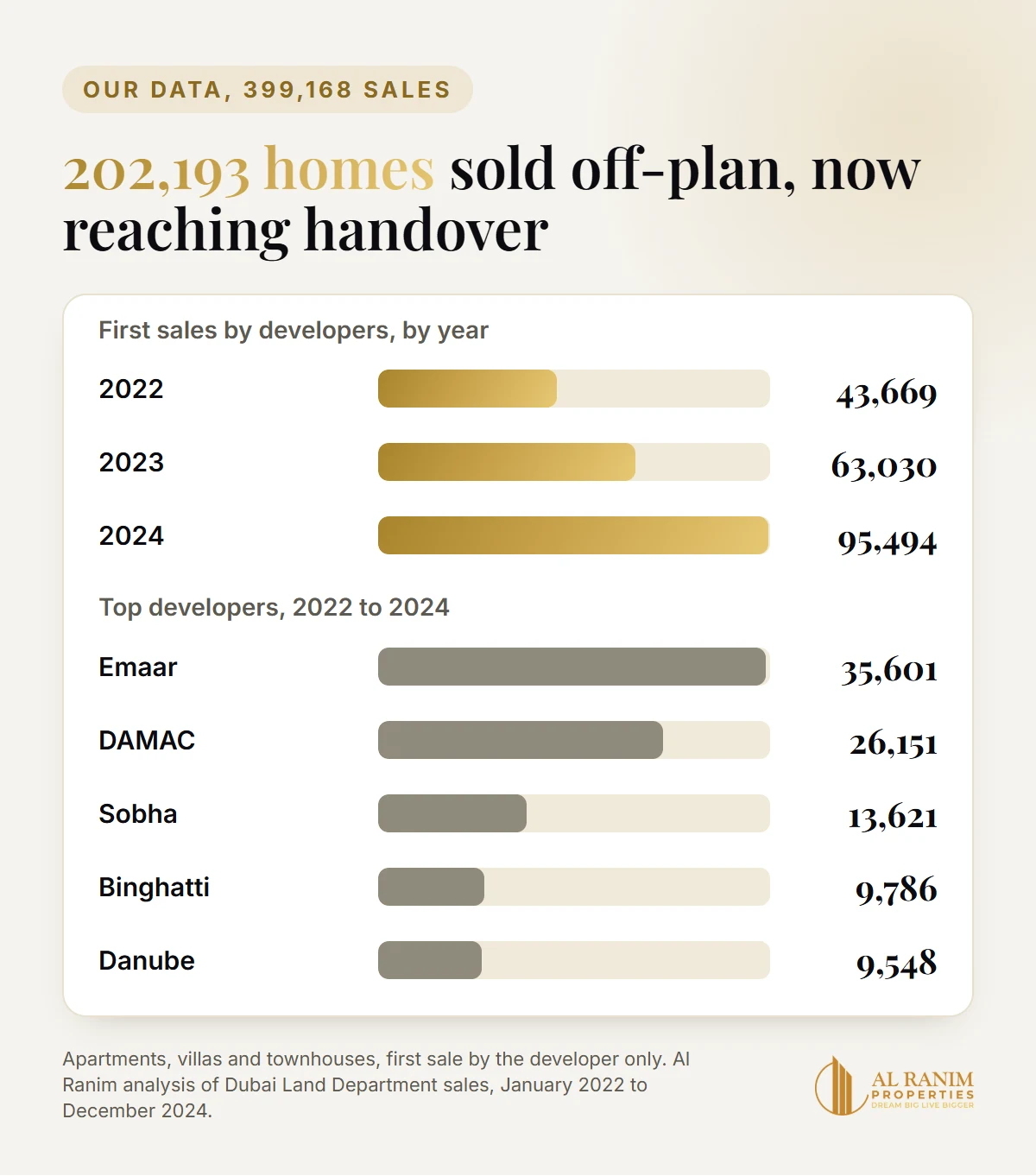
The highest number of units sold were for Emaar with 35,601 units sold, followed by DAMAC with 26,151 units sold, Sobha with 13,621 units sold, Binghatti with 9,786 units sold and Danube with 9,548 units sold. The highest number of units sold in a particular area were in Jumeirah Village Circle with 22,240 units sold and then Business Bay with 15,227 units sold. It should also be noted that the year in which a unit is sold does not always equate to the year in which the unit is handed over. For completed projects in 2025, Cavendish Maxwell has estimated the average construction period to be 942 days (approximately two and a half years). This means that a significant number of transactions from 2022-2024 are now reaching handover.
The Property Handover Process in Dubai, Step by Step
Each developer will perform handover in a slightly different manner. The details of each developer’s handover process are outlined in the sales agreement. However, each developer typically follows a similar process for handover, which runs as follows.
- Completion certificate awarded to the property. On the vast majority of mainland properties these are awarded by Dubai Municipality.
- Completion registration is undertaken by the developer to the Dubai Land Department for the completed property.
- The developer will issue a handover letter to you which will contain instructions on how to receive the property and will also state any balance due.
- Balance (or mortgage via bank) is paid and the developer will issue a completion of payment letter.
- A snagging is carried out by either you or your snagging company and a snag list is provided to the developer.
- The developer will attend to all issues on the snag list. These will then be inspected by you.
- A handover sheet is completed, you receive the keys and cards and the property will be registered to you. The Oqood will be replaced by a title deed.
- You will set up a DEWA account. If the building uses the district cooling system, cooling will be arranged. A move in permit can be arranged through the building manager.
These steps are in the best interest of the end buyer. Executive Council Resolution No. 6 of 2010 has been put into place to ensure that once the completion certificate is issued and payment is made by the buyer the developer shall not refuse registration or handover of the property. If a developer refuses to register the property the Dubai Land Department may register the property.
What these words mean
- Completion certificate: A certificate issued upon the completion of a development. For mainland developments Dubai Municipality usually issues this certificate.
- Oqood: Registration of an off plan deal by the Land Department. At handover this is replaced by a title deed.
- Escrow account: An account set up for a development by a bank. Buyer funds are held within this account and transferred to the developer as the development progresses.
- Mollak: The system used by the Land Department for the approval and collection of service charges for each development.
- District cooling: A cooling service provided to a development by a cooling company and billed separately from DEWA.

What You Pay at Handover
The final handover payment is the largest outstanding sum but there are also smaller sums outstanding at handover. Make provision for all of these.
| Cost | Amount | Who sets it |
|---|---|---|
| Final instalment | As per your payment plan | Sale contract |
| Title deed for a newly completed home | AED 540 per unit, if your contract puts it on you | Dubai Land Department |
| DEWA security deposit | AED 2,000 apartment, AED 4,000 villa | DEWA |
| DEWA activation | AED 125 (small meter) plus AED 30 in fees | DEWA |
| Service charges | Rate per sq ft approved by RERA | Mollak service charge index |
| Mortgage registration (if any) | 0.25% of the loan | Dubai Land Department |
| Snagging inspection | From about AED 500 | Snagging company |
DLD first-time registration fee and DEWA figures as published on 6 November 2026. District cooling charges vary by building and provider.
If you are obtaining a mortgage for the final payment, start as early as possible. First time expatriate buyers in the UAE can obtain a mortgage of up to 80% of the value of a property up to AED 5 million. UAE nationals can obtain up to 85%. Since February 2025, the fees charged by the broker and by the Land Department can no longer be added to the mortgage. These fees must be paid in cash.
The DEWA deposit will remain with DEWA during the ownership of the property and will be released at the time of sale.
Mollak is the charge collection system utilised by the Land Department. Service charges are collected through this system. Before move in the approved service charge for the building can be obtained from the service charge index for Dubai Land Department.
Are you unhappy with the total on your handover letter? We can help off plan buyers match up charges on the handover letter to the sales contract. Please send us your handover letter via WhatsApp.
How Much Does Snagging Cost in Dubai?
Snagging fees in Dubai are either charged per number of bedrooms or per area. The following table compares the published snagging fees to the typical size of property in each category. The typical sizes are the median sizes of properties in the Land Department sales data.
| Home | Typical size | Published snagging fee |
|---|---|---|
| Studio | about 415 sq ft | AED 500 to 799 |
| 1 bed apartment | about 752 sq ft | AED 500 to 1,200 |
| 2 bed apartment | about 1,209 sq ft | about AED 1,200 |
| 3 bed apartment | about 1,809 sq ft | AED 1,800 to 1,900 |
| 3 or 4 bed townhouse | about 1,873 to 2,797 sq ft | about AED 2,500 |
| Villa | 3,500 to 6,000 sq ft (price list band) | about AED 3,500 |
Fees from snagging companies' own price lists, seen 6 November 2026. Sizes are the median of first off-plan sales from 2022 to 2024 in Dubai Land Department data (Al Ranim analysis); villa sizes come from the price lists.
All fees must be provided before agreement. Some companies charge extra for a follow up inspection to check the snagging work and for thermal imaging. One company charges from AED 400 for thermal imaging. Another charges AED 500 for a single visit or AED 700 for a package that includes the follow up visit. A one bedroom of around 750 sq ft is near the transition between two fee categories for some companies. Therefore ask for a firm quote based on the size of the property in your sales agreement.
Inspection times for a villa are usually between four and eight hours and for an apartment between two and four hours. Reports are usually given within one or two days of the inspection.
Snagging Checklist: What to Check Room by Room
Snagging should include both visible and invisible fittings. The following list may be helpful when carrying out snagging or confirming all items on the check list.
- Walls and ceilings: Stains and damp under balconies and bathrooms, uneven finishes, cracks.
- Floors and tiles: Uneven joins, missing silicone or missing grout, chipped or hollow tiles.
- Doors and windows: Gaps in sealing, doors that do not lock or stick, sliding doors that drag and balcony doors that allow water ingress.
- Bathrooms and kitchen: Leaks under sink, slow draining, issues with hot water, issues with water pressure and any floor that slopes away from the drain.
- Electrics: All switches and sockets, fuses, earth and lighting.
- Air conditioning: All rooms should be cooled and thermostat should operate correctly whilst the drainage from the condensate should not drip.
- Balconies and roofs: No standing water after a test, drains free from rubble or sand and waterproofing.
- Against the contract: Area, parking, layout, finishes agree with the floor plan and sales contract.
Leave showers and taps running for a number of minutes. Turn on all air conditioning. Flood bathroom and balcony floors to check drainage. Take pictures of all faults using a wide shot to indicate the location of the fault.
How to Write a Snag List (Snagging Report) the Developer Will Act On
- Number each problem and reference the problem in the context of the building e.g. "master bathroom, tile left of shower drain"
- For every problem take both a close up and a wide shot.
- Distinguish between aesthetic problems and non-aesthetic problems such as electrics, leaks, air conditioning etc.
- Once the snagging list has been prepared send it via email or via the developer’s handover process. Use the email to record when the list was sent.
- Book a follow up inspection prior to handover and ask the developer for a date by which the snags will be dealt with.
Can You Refuse Handover Because of Snags?
Usually not. Standard snags are listed and repaired prior to handover rather than used as a reason to refuse the property. Only in the case of a material defect that renders the property unusable or material change to the agreed property by the developer can a buyer apply to the court to terminate the contract.
We were unable to find a regulation from RERA or the Land Department that provides for a specific number of days within which a developer must deal with snags prior to handover, a format for the snagging list or a right for a buyer to inspect the property. These provisions are contained in the sales agreement and should be reviewed prior to handover.
There is a buyer remedy for material defects. Resolution No. 6 of 2010 provides that a buyer can apply to the court to terminate the contract if there has been a material change to the agreed property or if the property is rendered unusable at handover due to material defects in the property. Issues such as chipped paint are not covered.
Think twice before delaying handover
Delaying possession can cost you twice. On 2 October 2025 the Rental Disputes Centre confirmed that service charges can begin at completion even if the owner has not yet taken possession, especially if the delay is due to the buyer. Law No. 6 of 2019 also means your one year coverage for installations begins at the completion certificate, not possession.
Area of the unit is also important. If the net area is more than 5% less than the agreed area in your contract then the developer must make compensation in proportion to the purchase price under Resolution No. 6 of 2010. If the area is more than agreed then you cannot be charged for the difference in area unless this is specified in your contract.
After Handover: How Long the Developer Must Fix Defects
Omitted snags are not lost. There is a period after possession for the developer’s responsibility under Dubai law.
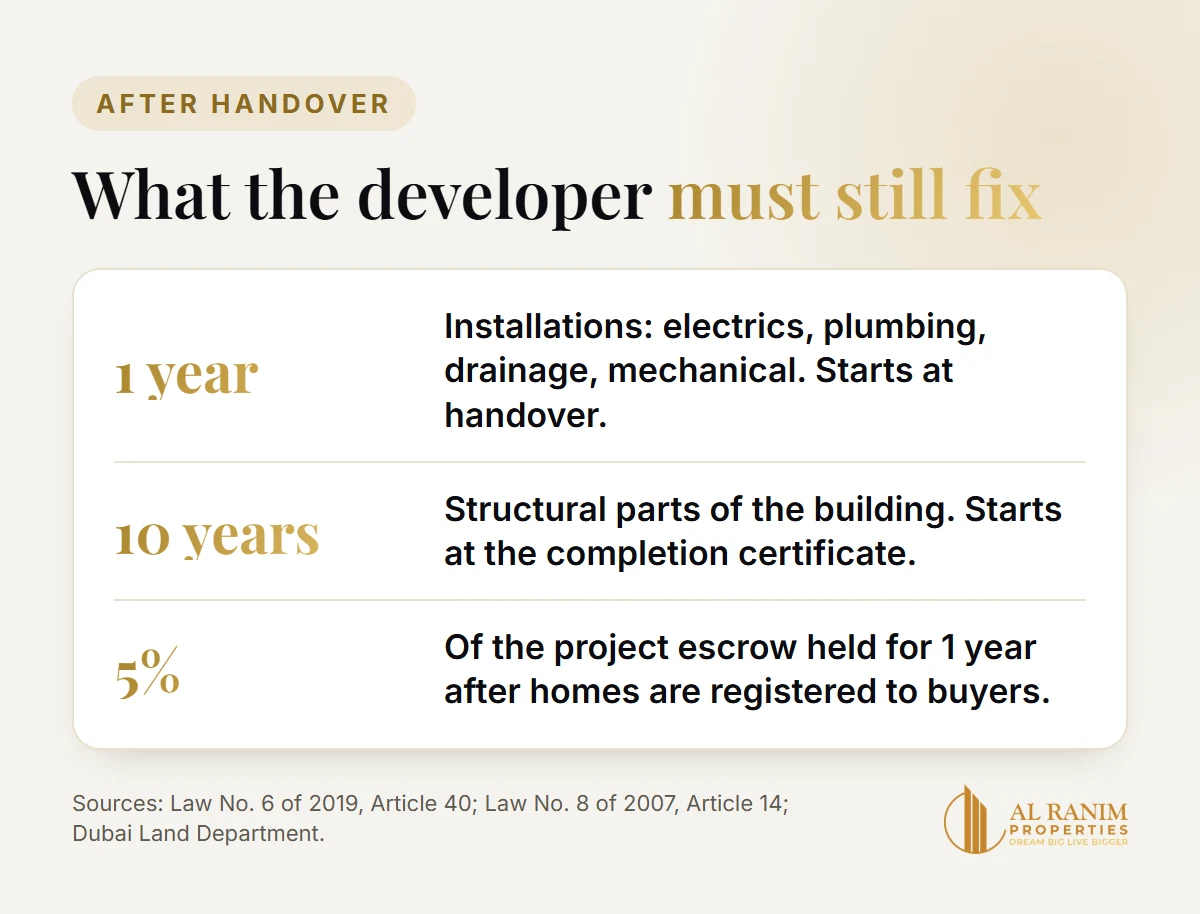
Law No. 6 of 2019, Article 40 provides that the developer shall provide repair or replacement for defective installations for a period of one (1) year from the time the property is handed over to the purchaser. Installations include drainage installations, sanitary installations, plumbing installations, electrical installations and mechanical installations.
Law No. 6 of 2019, Article 40 also mandates that the developer shall repair any structural defects in the project for a period of ten (10) years from the date of issue of the completion certificate.
Under the escrow law (Law No. 8 of 2007) 5% of the escrow on the project shall be held back until one year after the registration of the units to the buyers. This is referred to by the Land Department as a guarantee that any defect at completion or within the first year will be rectified.
Any problems after possession should be reported as soon as possible to the community manager or developer. Please also provide a picture of the problem along with the date of the picture. If the problem is not responded to you can raise a dispute under Law No. 6 of 2019 to the Rental Disputes Centre. The Rental Disputes Centre can handle disputes relating to both owners and rent. There may be a longer warranty in your contract than that provided by law. Keep it with your handover papers.
Looking to rent following handover? We can help new owners locate a tenant, register the Ejari and list the property to start receiving rent as soon as possible. Please message us on WhatsApp.
Choosing a Snagging Company in Dubai
We found no provision in Dubai law that stops a buyer snagging their own property and there is no provision that only allows a registered property observer to carry out snagging. In this jurisdiction most snagging companies operate under a property observer licence. Meydan Free Zone has advised that prior approval from RERA is required for such a licence. Before using a snagging company please ask the following questions:
- What licence do you hold and has your company received RERA approval for snagging?
- Do you carry out electrical, thermal imaging, or moisture testing as part of your snagging service?
- Can you show me a previous snag report sent to a developer?
- Do you provide a numbered photographic report?
- Is the second visit free or is it charged?
- Do you give a fixed quote for the size of the property including VAT?
Buying From Abroad: Snagging and Handover Without Flying In
Some off plan property buyers are not based in the UAE but a snagging service can be arranged for them and provide pictures and snag reports the same day. At handover the developer will request a notarised letter of authority or power of attorney. This allows a third party to sign and receive the keys on behalf of the buyer. This must be arranged prior to the handover appointment. A DEWA account can be established for the owner of the property via the contract or title/sale agreement either using an Emirates ID or a passport via the online service.
The Bottom Line
- Issues should be remedied prior to signing but do not delay handover for minor faults.
- Installation faults are remedied by the developer for 1 year from handover. Structural faults are remedied for 10 years from certificate of completion.
Is your handover pending on an off plan property? We can assist off plan property buyers with snagging appointments, interpretation of the handover letter and final payments. Message us or take a look at off plan properties in Dubai.
Al Ranim Forum
Have a question about Dubai property?
Ask the community and our licensed team about buying, renting or selling in Dubai. No account needed.
FAQ
Frequently asked questions
Snagging occurs before the taking of possession. The property is viewed before possession to identify any omissions or defects. These are noted and a snag list is created and given to the developer to be dealt with.
No. We found no law in Dubai that requires snagging. However, faults are most easily dealt with at this stage as the developer is responsible for defects noted on the snag list at its expense prior to the handover of the property.
Snagging prices are published from approximately AED 500 for a studio, AED 2,500 for a townhouse and AED 3,500 for a villa. Some snagging firms may charge a fee for thermal imaging and a follow up visit.
A third party snagging service is engaged by the buyer and costs are incurred by the buyer. Any omission or defect identified on the snag list is rectified by the developer.
The time for rectification prior to handover is specified within the sales agreement. Under Law No. 6 of 2019 there is a period of one year from the time of handover to rectify defective installations. For structural defects there is a period of ten years from the issue of the completion certificate.
They can. Since October 2025 the Rental Disputes Centre has found that service charges can start at completion especially if the buyer is delaying possession.
A snagging report is a report produced by the inspector that shows the position and image of any defect identified along with a description of the defect. This is sent to the developer as your snag list.
DEWA charges a villa deposit of AED 4,000 and an apartment deposit of AED 2,000 in addition to activation charges. These deposits are refunded when the property is sold.
Work with Al Ranim Properties
Found this useful? Talk to a consultant about your own situation.